Skip to content

FEATURED CASE STUDY • ACTIVE INITIATIVE

Turning a school-supply campaign into a structured system of community participation.

Preparing a child for school may depend on resources that many families must struggle to assemble at the beginning of the academic year.

The ODEP School Kits Initiative was structured around a clear community objective: mobilize support for 2,026 school kits for the 2026–2027 school year while creating a transparent, accessible, and dignity-centered campaign experience.

The initiative connects community development, social mobilization, campaign strategy, digital communication, public engagement, and implementation planning within one coordinated system.

Category
Community Development & Digital Campaign
Maturity
Active Initiative
Deadline
July 30, 2026

Discuss a Community Initiative

Abstract representation of the ODEP School Kits participation system. Illustrative only.

Project Snapshot

Project snapshot

Organization
ODEP
Full organization name
Organisation pour le Développement de Port-Margot
Location
Port-Margot, Nord, Haiti
Campaign
ODEP School Kits 2026
School year
2026–2027
Project area
Community Development & Digital Campaign
Maturity
Active Initiative
Target
2,026 school kits
Unit contribution
$20 per kit
Estimated target value
$40,520
Deadline
July 30, 2026

Kit content

  • School bag
  • Notebooks
  • Pens and pencils

Deadline rule

July 30, 2026, or when verified campaign progress reaches 100 percent, whichever occurs first.

Dulain’s contribution

  • Campaign strategy
  • Message architecture
  • Landing-page strategy and development
  • Public communication
  • Social-mobilization design
  • Visual direction
  • AI-assisted media production
  • Campaign UX
  • Evidence-aware reporting architecture

Official public channels

The official ODEP School Kits campaign website and public social channels will be connected here once their public URLs and publication status are confirmed.

The Community Context

The beginning of the school year can place a significant burden on families.

School participation depends on more than enrollment. Children need the basic materials required to enter the classroom prepared, while parents must manage school-related expenses alongside other household responsibilities.

In Port-Margot and surrounding communities, a school-kit initiative can support children while also reducing part of the immediate preparation burden carried by families. The communication challenge is to explain that reality without reducing children or parents to hardship.

  1. 01

    School readiness

    Children need essential materials to begin the academic year with greater confidence and practical preparation.

  2. 02

    Family pressure

    The cost of school supplies can add to existing household responsibilities.

  3. 03

    Community responsibility

    Local organizations, residents, supporters, and members of the diaspora can contribute to one shared objective.

  4. 04

    Geographic access

    Campaign communication must reach supporters inside Haiti and abroad through practical digital channels.

  5. 05

    Dignity-centered representation

    Children and parents must be represented with respect, agency, cleanliness, and humanity—not as promotional symbols of poverty.

The Challenge

How do you transform a large community target into a campaign people can understand, trust, and act upon?

A target of 2,026 school kits requires more than an announcement. Potential supporters need to understand the purpose, the unit contribution, the kit contents, the deadline, the organization, the participation options, and how support can be confirmed.

The campaign also needs one consistent message across the landing page, Facebook communication, visual materials, video, WhatsApp, email, and community engagement.

DIMENSION 01

A clear participation unit

Translate the total campaign target into one understandable action: one complete school kit for $20.

DIMENSION 02

Public trust

Explain who is organizing the initiative, what the campaign supports, and how participation can be confirmed.

DIMENSION 03

Cross-channel consistency

Maintain the same target, deadline, message, visual identity, and calls to action across digital and public communication.

DIMENSION 04

Accessible participation

Provide practical pathways for supporters in Haiti and abroad to obtain information and confirm financial or material support.

DIMENSION 05

Responsible representation

Communicate the need without exploiting children, exaggerating hardship, or publishing unverified results.

The Strategic Response

One campaign architecture connecting message, participation, digital access, and accountability.

The campaign was structured as an integrated participation system. Instead of treating the landing page, social posts, videos, contact channels, and donation information as separate outputs, each component was connected to the same objective, target, audience logic, campaign language, and public-accountability standards.

PILLAR 01Implemented

Campaign Architecture

Define the target, participation unit, deadline, campaign logic, calls to action, and relationship between community need and public participation.

  • 2,026-kit target
  • $20 participation unit
  • Deadline logic
  • Kit-content definition
  • Core calls to action
  • Campaign-message hierarchy
PILLAR 02Implemented

Message Architecture

Translate the campaign purpose into clear, memorable, and action-oriented public language.

  • Campaign headline
  • Supporting messages
  • Parent-and-child framing
  • Participation language
  • Deadline communication
  • Haitian Creole calls to action
PILLAR 03Implemented

Digital Campaign Platform

Create a responsive landing page that explains the initiative, campaign target, participation options, organization, and contact pathways.

  • Responsive campaign landing page
  • Campaign explanation
  • Kit information
  • ODEP information
  • Contact and support pathways
  • Donation-confirmation actions
  • Mobile-first campaign experience
PILLAR 04Implemented

Participation Pathways

Provide practical channels through which supporters can request information, confirm support, and communicate with the campaign team.

  • WhatsApp pathway
  • Email pathway
  • Material-support information
  • Financial-support information
  • Confirmation guidance
  • Contact information

Online card processing is considered but not represented as active. It requires formal approval, implementation, and verification before public claim.

PILLAR 05Active Production

Visual & Audiovisual Communication

Develop a coordinated visual and narrative system supporting awareness, emotional connection, campaign explanation, and calls to action.

  • Campaign imagery
  • Social communication
  • Video-scene architecture
  • Voiceover preparation
  • AI-assisted visual production
  • Editing preparation
  • Public campaign assets
PILLAR 06Active Refinement

Transparency & Evidence Architecture

Separate verified campaign facts from changing progress data and prepare public evidence for responsible publication.

  • Fixed target data
  • Dynamic-progress governance
  • Evidence slots
  • Asset-approval controls
  • Publication review
  • Future reporting structure

Dulain’s Contribution

Community purpose translated into campaign strategy, digital experience, and public action.

The contribution connected ODEP’s community objective with a structured campaign system. It included clarifying the campaign logic, developing the public message, directing the digital experience, organizing participation pathways, and preparing coordinated visual and audiovisual communication.

  1. 01

    Campaign Strategy

    Structured the relationship between the 2,026-kit objective, unit contribution, deadline, audiences, participation options, and public calls to action.

  2. 02

    Message Development

    Created clear campaign language connecting support for parents, hope for children, and practical public participation.

  3. 03

    Landing-Page Strategy & Development

    Directed and developed the campaign’s responsive digital platform, information architecture, calls to action, and contact pathways.

  4. 04

    Campaign UX

    Organized the visitor journey from understanding the need to identifying a participation method and confirming support.

  5. 05

    Visual & Editorial Direction

    Established visual, message, dignity, continuity, and campaign-consistency standards across website, social, and audiovisual materials.

  6. 06

    AI-Assisted Media Production

    Designed and guided visual scenes, voice preparation, campaign storytelling, and production workflows under human creative direction.

Audience System

One campaign. Several participation contexts.

AUDIENCE 01

Local community

Residents, families, local supporters, educators, and community actors connected to Port-Margot.

Participation context

  • Community awareness
  • Material contributions
  • Local coordination
  • Campaign sharing
  • Distribution support

AUDIENCE 02

Haitian diaspora

Supporters abroad who remain connected to local development and education initiatives in Haiti.

Participation context

  • Financial support
  • Campaign amplification
  • Professional networks
  • Community association participation
  • Material-support coordination

AUDIENCE 03

Organizations & partners

Community groups, institutions, associations, businesses, and potential partners interested in education and local development.

Participation context

  • Partnership discussion
  • Group sponsorship
  • Material support
  • Campaign amplification
  • Operational collaboration

AUDIENCE 04

Individual supporters

People who want to support one or more kits through a clear and accessible participation unit.

Participation context

  • One-kit contribution
  • Multiple-kit contribution
  • Material donation
  • Campaign sharing
  • Support confirmation

Digital Campaign Platform

A landing page designed to move from understanding to participation.

The campaign landing page was structured as a focused public experience rather than a general organizational website. Its purpose is to explain the initiative, establish the target, show what one kit represents, present ODEP, provide participation information, and connect supporters to practical confirmation pathways.

  • Campaign hero
  • 2,026-kit objective
  • $20-per-kit participation unit
  • Campaign deadline
  • Kit-content explanation
  • Community-context section
  • About ODEP
  • Contact and support information
  • WhatsApp quick action
  • Email quick action
  • Donation-confirmation guidance
  • Responsive mobile experience
  • Public static architecture

Credit- and debit-card integration has been considered but must not be presented as active unless formally approved, implemented, and verified. The website provides participation information and confirmation pathways; it does not process payments.

Campaign Communication

A large target becomes actionable when the message remains clear and repeatable.

Primary campaign logic

Pou soulaje 2,026 paran, bay espwa ak 2,026 timoun.

Supporting message

Chak kit konte. Chak timoun konte.

Supporting message

Pa rete gade. Aji kounye a.

Unit message

One school kit = $20

Deadline message

Campaign deadline: July 30, 2026, or when verified progress reaches 100 percent.

  1. PRINCIPLE 01

    One purpose

    Support school-year preparation for children and families.

  2. PRINCIPLE 02

    One understandable unit

    Translate participation into complete $20 school kits.

  3. PRINCIPLE 03

    One repeatable call to action

    Use consistent action language across digital, social, video, and direct communication.

  4. PRINCIPLE 04

    One evidence standard

    Do not publish changing campaign results without verification.

Participation Pathways

Support becomes easier when the next step is clear.

Campaign participation may begin through different channels, but each pathway must provide understandable information and a method for confirming support.

  1. STAGE 01

    Understand the campaign

    Review the purpose, target, kit contents, contribution unit, and deadline.

  2. STAGE 02

    Choose a participation method

    Identify whether the supporter is contributing money, school supplies, campaign visibility, or organizational support.

  3. STAGE 03

    Access contact guidance

    Use the campaign’s WhatsApp or email pathways to obtain or confirm relevant information.

  4. STAGE 04

    Confirm the contribution

    Provide the campaign team with the information needed to connect the support to the initiative.

  5. STAGE 05

    Preserve accountability

    Maintain appropriate campaign records while protecting personal donor information from public exposure.

Social Mobilization

The campaign depends on participation—not passive visibility.

Community campaigns become effective when information leads to conversation, sharing, contribution, coordination, and local ownership.

  1. 01

    Local awareness

    Community-level conversations, information sharing, and neighborhood-scale participation are actively pursued.

  2. 02

    Diaspora engagement

    Supporters abroad are invited to relay the campaign through personal, professional, and community networks.

  3. 03

    Social-media amplification

    Coordinated posts, visual materials, and campaign updates are prepared for use across social channels.

  4. 04

    Community and organizational partnerships

    Interested organizations, businesses, associations, and community groups may connect with the initiative through defined pathways.

  5. 05

    Volunteer and operational coordination

    Volunteer and operational involvement may be structured around communication, coordination, and preparation activities.

Mobilization descriptions represent active campaign directions. No specific volunteer, partner, or audience figures are claimed prior to verification.

Responsible Representation

Children should be represented with dignity, not used as symbols of hardship.

  1. PRINCIPLE 01

    Dignity before emotional pressure

    Do not dramatize children’s circumstances to force a response.

  2. PRINCIPLE 02

    Children before campaign imagery

    The child’s dignity is more important than creating a powerful promotional visual.

  3. PRINCIPLE 03

    Clean and respectful representation

    Children should appear clean, appropriately dressed, safe, and naturally engaged in educational or community contexts.

  4. PRINCIPLE 04

    No staged suffering

    Do not manufacture sadness, distress, or degrading environments for campaign communication.

  5. PRINCIPLE 05

    Privacy and authorization

    Do not publicly expose identifiable children without appropriate purpose, permission, and protection.

  6. PRINCIPLE 06

    Context before stereotype

    Represent Haitian schools and communities accurately without reducing them to one visual narrative.

  7. PRINCIPLE 07

    Human responsibility before automation

    AI-assisted visuals require human review for identity, realism, cultural context, dignity, and publication suitability.

AI-Assisted Production

Technology supported the campaign story. Human direction protected its purpose.

The campaign’s visual and audiovisual development combined communication strategy, scene planning, visual references, AI-assisted production, voice preparation, editing, and continuity review.

  1. STAGE 01

    Campaign narrative

    Define the purpose, audience, emotional tone, campaign facts, and action logic.

  2. STAGE 02

    Scene architecture

    Translate the campaign into structured educational, classroom, family, school, and community scenes.

  3. STAGE 03

    Visual-reference development

    Create and validate references for Haitian children, school environments, uniforms, supplies, ODEP identity, and community context.

  4. STAGE 04

    AI-assisted generation

    Produce campaign visuals and motion assets while controlling identity, gesture, clothing, setting, realism, and cultural accuracy.

  5. STAGE 05

    Voice preparation

    Develop narration with clear tone, pacing, pronunciation, and Haitian Creole delivery.

  6. STAGE 06

    Editing preparation

    Organize scenes, audio, graphics, subtitles, campaign messages, logo placement, and final calls to action.

  7. STAGE 07

    Ethical and continuity review

    Review child representation, realism, identity continuity, campaign accuracy, cultural context, visual defects, and publication readiness.

Selected supporting technologies

  • Lovable
  • Google Flow
  • ElevenLabs
  • Adobe Premiere Pro
  • AI-assisted visual-production tools

Presented as supporting tools. No endorsement or partnership with technology companies is implied. AI is not presented as the author of the campaign.

Transparency Architecture

Fixed campaign facts and changing campaign results must be managed differently.

Fixed campaign data

  • Campaign name
  • Target of 2,026 kits
  • $20 unit contribution
  • Estimated target value of $40,520
  • Kit contents
  • School year 2026–2027
  • Deadline of July 30, 2026
  • ODEP identity
  • Port-Margot campaign context

Dynamic campaign data

  • Kits collected
  • Amount raised
  • Donor count
  • Progress percentage
  • Materials received
  • Distribution totals
  • Remaining campaign need
  • Final campaign result

Verified campaign data will be connected during Sprint 6.

Fixed campaign facts may remain public once verified. Dynamic results must be updated from reliable campaign records and must include an appropriate verification date before publication.

Method in Practice

The initiative illustrates how listening, alignment, design, and mobilization can support collective action.

The ODEP School Kits Initiative illustrates several dimensions of The Dulain Method™.

  1. LISTEN

    Understand the school-preparation burden faced by families and the perspectives of community actors.

  2. UNDERSTAND

    Clarify the campaign purpose, target population, participation context, materials, audiences, and implementation realities.

  3. ANALYZE

    Examine campaign requirements, communication channels, support pathways, digital-access conditions, logistics, and evidence needs.

  4. ALIGN

    Connect ODEP leadership, community actors, supporters, diaspora audiences, messaging, and campaign responsibilities.

  5. DESIGN

    Create the campaign architecture, landing page, message system, participation pathways, visual identity, and media-production plan.

  6. IMPLEMENT

    Develop the public platform, campaign communication, support pathways, visual materials, and mobilization activities.

  7. STRENGTHEN

    Create reusable campaign structures, communication templates, digital systems, and evidence controls.

  8. SUSTAIN

    Support continued community engagement, transparent reporting, institutional learning, and future ODEP initiatives.

Current State

A structured active initiative with developed campaign systems and evidence still to be connected.

Developed or implemented

  • 2,026-kit campaign architecture
  • $20 participation unit
  • Campaign message system
  • Responsive landing-page architecture
  • Campaign information structure
  • ODEP organizational context
  • WhatsApp and email support pathways
  • Donation-confirmation guidance
  • Visual campaign direction
  • Social communication foundations
  • Evidence-aware data architecture

Active or continuing

  • Campaign mobilization
  • Public communication
  • Community and diaspora outreach
  • Visual and audiovisual production
  • Support confirmation
  • Operational preparation
  • Progress verification
  • Evidence collection
  • Future distribution documentation

Pending or conditional

  • Verified public progress figures
  • Real campaign evidence connected to the portfolio
  • Credit/debit-card integration, if formally approved
  • Final audiovisual completion and publication
  • Final campaign-result reporting

The ODEP School Kits Initiative remains an Active Initiative. No campaign completion, distribution completion, or final result is claimed.

Campaign Evidence

Campaign strategy translated into public-facing digital, social, audiovisual, and print assets.

The selected evidence documents how ODEP’s School Kits initiative was communicated across the campaign landing page, promotional video, Facebook presence, and institutional brochure.

Campaign status reported by ODEP: 50% of the stated objective as of September 3, 2026. This is a dated campaign-status statement, not a final distribution outcome.

digitalImage evidence

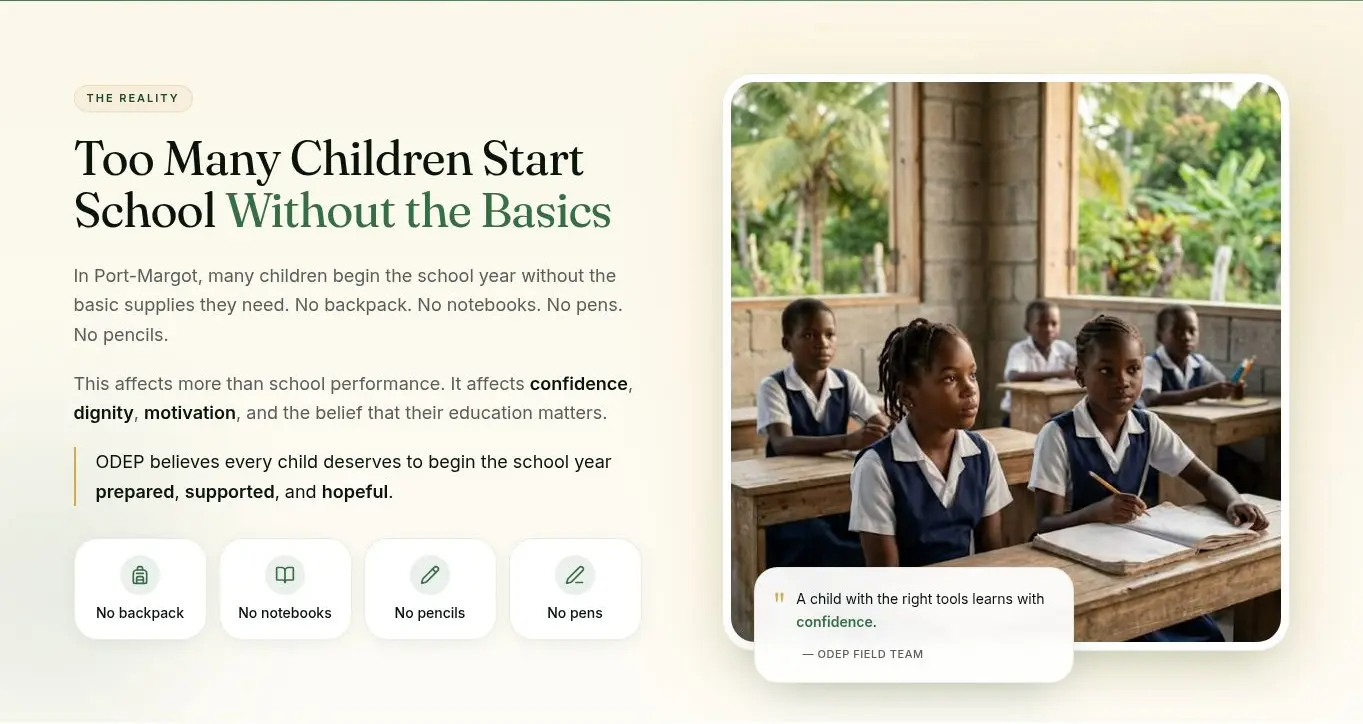
School Kits Campaign Landing Page

ODEP School Kits campaign landing page section explaining how missing school supplies affect confidence, dignity, motivation, and readiness to learn.

Public landing-page section translating the campaign’s educational-access rationale into a clear, visual, dignity-centered narrative.

Dated campaign-interface excerpt; donation and progress data are not shown.

audiovisualVideo evidence

School Kits Campaign Video

AI-assisted promotional video illustrating the School Kits campaign message and anticipated community-distribution experience. This portfolio-safe edition excludes donation-access screens while preserving the original background music owned by Dulain François Charles.

AI-assisted illustrative campaign media — not documentary footage.

Original background music © Dulain François Charles. ODEP is the beneficiary of the campaign media; no transfer of music ownership is implied.

campaignImage evidence

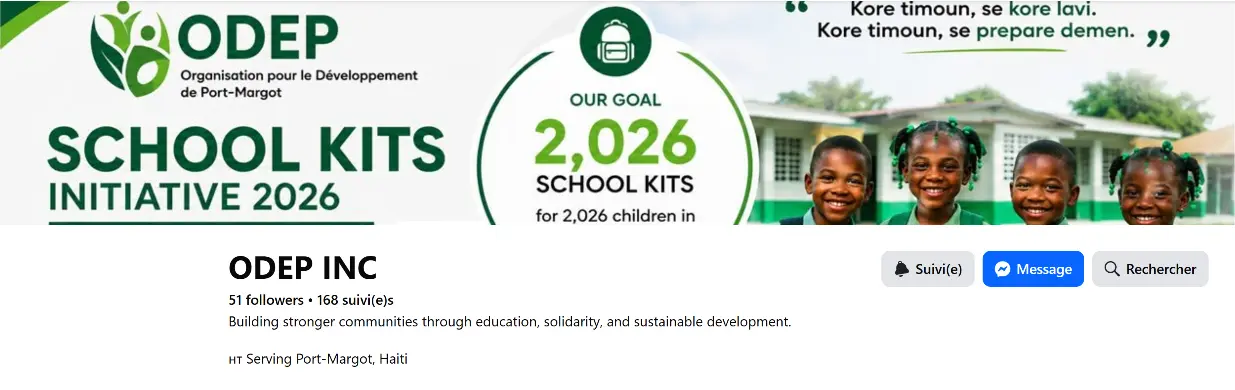
Facebook Campaign Presence & Cover Banner

ODEP Facebook page header showing the School Kits Initiative campaign cover and the ODEP INC public page identity.

Coordinated Facebook page branding extending the 2026–2027 School Kits initiative across ODEP’s public social presence.

The 2,026-kit figure shown is the campaign’s stated launch objective, not a verified final distribution result.

campaignDocument evidence

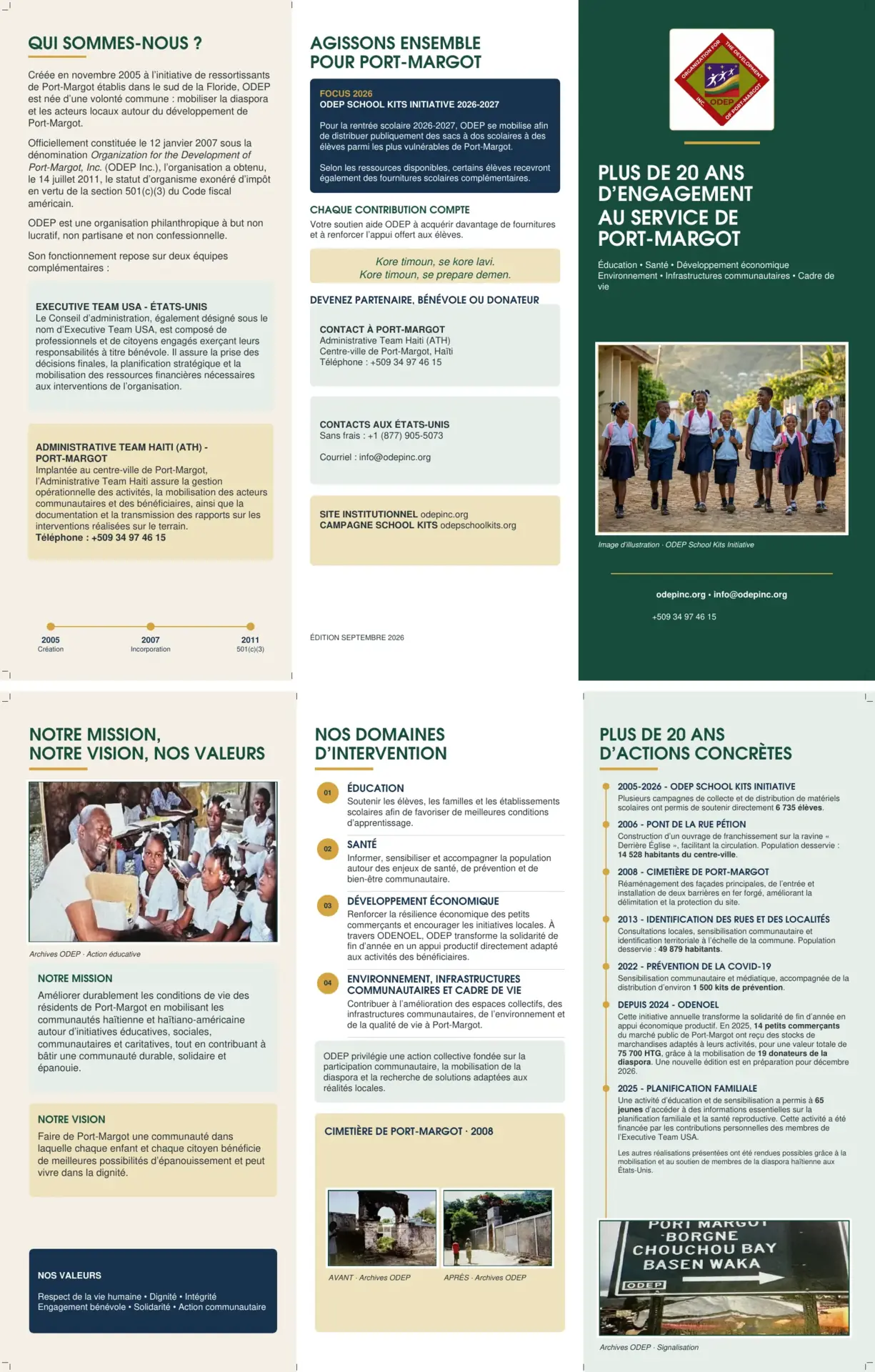
Institutional Brochure — School Kits 2026

Front and reverse sides of ODEP’s September 2026 French tri-fold institutional brochure, including mission, governance, intervention areas, past initiatives, and School Kits campaign information.

French tri-fold brochure connecting ODEP’s mission, governance, intervention areas, institutional history, and 2026 School Kits focus.

View the final brochure PDF

Additional field evidence may be added following the September 2026 distribution and publication review.

Professional Value

A community campaign becomes stronger when purpose, participation, communication, and evidence work together.

  • Community Development

    Connecting institutional purpose with participation pathways rooted in Port-Margot and its wider community.

  • Social Mobilization

    Structuring how information becomes conversation, coordination, and practical participation across audiences.

  • Campaign Strategy

    Translating a large community target into an understandable unit of action supported by a coherent message system.

  • Digital Communication

    Coordinating landing page, social, messaging, video, and public communication under one campaign architecture.

  • Human-Centered Web Design

    Designing a campaign platform that supports understanding, decision, contact, and confirmation without imposing complexity.

  • AI-Assisted Media Production

    Directing visual and audiovisual production while protecting cultural context, identity, dignity, and human authorship.

Lessons

Community participation grows when the objective is understandable and the pathway to action is clear.

  1. LESSON 01

    A large target needs a small understandable unit

    The $20 kit transforms a campaign-wide objective into one practical participation decision.

  2. LESSON 02

    Digital visibility is not enough

    A campaign platform becomes useful when it connects information, motivation, contact, confirmation, and accountability.

  3. LESSON 03

    Dignity is part of campaign design

    Child and family representation requires deliberate visual, editorial, privacy, and publication controls.

  4. LESSON 04

    Changing results require verification

    Campaign progress should not be treated as permanent website copy; it requires reliable records, review, and dated publication.

  5. LESSON 05

    Community ownership requires multiple pathways

    Local residents, diaspora supporters, organizations, and individual contributors may engage differently while supporting one shared objective.

From community need to collective participation

Does your initiative need a clear public objective, accessible participation pathways, and a communication system people can trust?

Let’s examine the community context, audiences, message, digital platform, participation channels, implementation responsibilities, and evidence requirements — and design a campaign that can move from awareness to practical action.