Skip to content

FEATURED CASE STUDY • ACTIVE INITIATIVE

Building a dignity-centered communication ecosystem for RAFELD.

RAFELD required more than individual communication materials. The initiative needed a coherent system connecting institutional visibility, public awareness, stakeholder messaging, digital presence, campaign assets, and audiovisual storytelling — while protecting the dignity of women affected by violence, displacement, and migration-related vulnerability.

This case study examines how communication strategy, digital development, visual systems, and AI-assisted production were brought together within one responsible communication architecture.

Category
Institutional & Humanitarian Communication
Maturity
Active Initiative
Period
2025–2026

Discuss a Similar Challenge

Abstract representation of the RAFELD communication system. Illustrative only.

Project Snapshot

Project snapshot

Organization
RAFELD
Location
Ouanaminthe, Nord-Est, Haiti
Period
2025–2026
Project area
Institutional & Humanitarian Communication
Maturity
Active Initiative
Framework
Resilience and empowerment of women survivors and migrants affected by forced return or refusal at the border.

Institutional context

Supported through the FEF-OSC 2025–2026 framework of the Embassy of France in Haiti.

Dulain’s contribution

  • Communication strategy
  • Website development
  • Campaign architecture
  • Message development
  • Visual communication
  • AI-assisted audiovisual production
  • Digital communication infrastructure

Official Public Channels

Explore RAFELD’s official public platforms for organizational information, institutional communication, and current public activity.

The Context

Communicating a sensitive initiative requires clarity, consistency, and dignity.

RAFELD operates within a context where communication must address institutional partners, communities, women seeking support, public audiences, and other stakeholders.

The subject matter requires particular care. Messages must inform without exposing people. They must communicate urgency without sensationalizing vulnerability. They must support institutional visibility without allowing donor recognition or campaign branding to overshadow the people the initiative exists to serve.

  1. 01

    Institutional clarity

    Explain the organization, initiative, purpose, and available support clearly.

  2. 02

    Dignity-centered language

    Avoid victimizing, sensationalizing, or reducing women to their experience of displacement, violence, or forced return.

  3. 03

    Multi-audience communication

    Create messages that remain understandable across institutional, community, public, and digital contexts.

  4. 04

    Multi-format consistency

    Maintain one communication logic across website, radio, campaign materials, social communication, and audiovisual production.

  5. 05

    Responsible visibility

    Make the initiative visible while protecting privacy, dignity, context, and editorial responsibility.

The Challenge

The project needed a communication system — not a collection of isolated materials.

A website, a radio spot, a postcard, a banner, and an audiovisual production can easily communicate different versions of the same initiative.

Without a shared communication architecture, messages become inconsistent, institutional identity becomes fragmented, and sensitive issues may be communicated without sufficient ethical control. The challenge was therefore to connect every communication format to one strategic foundation.

DIMENSION 01

Message coherence

Develop language that remains consistent across institutional, community, campaign, and digital communication.

DIMENSION 02

Dignity and protection

Communicate sensitive realities without exposing, stereotyping, dramatizing, or objectifying women.

DIMENSION 03

Institutional visibility

Strengthen RAFELD’s public presence and credibility through a clear and structured digital identity.

DIMENSION 04

Production continuity

Maintain visual, narrative, character, and message consistency across multiple AI-assisted and human-produced media assets.

The Strategic Response

One communication architecture across every public touchpoint.

The response was structured as an integrated communication ecosystem. Instead of treating the website, campaign materials, radio content, and audiovisual production as separate assignments, each element was connected to the same project purpose, audience logic, dignity standards, and institutional message.

PILLAR 01

Communication Architecture

Structure the initiative’s message hierarchy, audience logic, public explanation, calls to action, and relationship between institutional and community communication.

  • Core message framework
  • Audience logic
  • Public explanation
  • Calls to action
  • Cross-format consistency
PILLAR 02

Dignity-Centered Messaging

Develop language that recognizes women’s experiences without reducing them to vulnerability, displacement, or trauma.

  • Respectful terminology
  • Non-sensational message framing
  • Support-oriented calls to action
  • Ethical editorial controls
  • Privacy-aware storytelling
PILLAR 03

Institutional Digital Presence

Create a structured public website supporting organizational visibility, project explanation, contact pathways, collaboration, and institutional credibility.

  • Public website
  • Project information architecture
  • Contact pathway
  • Collaboration pathway
  • Mobile-responsive experience
  • Professional digital identity
PILLAR 04

Campaign Communication System

Translate the strategic message into coordinated radio, print, event, public-awareness, and social communication formats.

  • Radio spots
  • Awareness postcards
  • Banners
  • T-shirt communication
  • Public campaign messages
  • Social communication assets
PILLAR 05

AI-Assisted Audiovisual Production

Use AI-assisted production tools under human creative direction to create a coherent audiovisual narrative with controlled identity, continuity, language, and dignity.

  • Script architecture
  • Master-image references
  • Image-to-video production
  • Voice production
  • Editing preparation
  • Continuity review
  • Ethical quality control
PILLAR 06

Communication Governance

Maintain consistency across messages, visuals, project maturity, institutional relationships, and public claims.

  • Approved terminology
  • Visual continuity rules
  • Content verification
  • Relationship-sensitive wording
  • Asset review
  • Publication controls

Dulain’s Contribution

Strategy, systems thinking, digital implementation, and creative direction.

The contribution connected strategic communication with practical production. It involved understanding the initiative, organizing the communication logic, developing public-facing systems, guiding visual and narrative continuity, and using digital tools to move from concept to implementation.

  1. 01

    Strategic Communication

    Clarified the relationship between institutional communication, public awareness, project explanation, support messaging, and campaign visibility.

  2. 02

    Website Strategy & Development

    Structured and developed RAFELD’s digital presence, public information architecture, contact pathways, and collaboration experience.

  3. 03

    Campaign Architecture

    Connected campaign messages and materials to one consistent communication foundation across radio, print, event, and digital formats.

  4. 04

    Visual & Editorial Direction

    Established message, layout, dignity, continuity, and public-communication standards across multiple formats.

  5. 05

    AI-Assisted Media Production

    Designed and guided an audiovisual workflow combining human strategy, AI-assisted visual production, voice generation, editing preparation, and continuity review.

Communication Ecosystem

A coordinated system across digital, audio, visual, and public formats.

Verified outputs and active production components, presented as a communication ledger rather than a gallery of previews.

ComponentState

Public website and digital presence

Digital — Institutional visibility, project explanation, and public reference.

Developed

Professional contact and collaboration pathways

Digital — Structured routes for institutional, community, and partner contact.

Developed

Professional email infrastructure

Digital — Domain-connected professional email supporting institutional communication.

Developed

60-second radio spot

Audio — Primary radio communication format for public-awareness broadcast.

Developed

30-second radio adaptation

Audio — Shorter broadcast variant preserving message and dignity standards.

Developed

Awareness postcard series (10 postcards)

Print — Community-facing postcard series structured within the campaign system.

Developed

Campaign banners

Print — Public-space visibility supporting the institutional and community message.

Developed

T-shirt communication

Print — Wearable format extending institutional visibility in events and community settings.

Developed

AI-assisted audiovisual production

Audiovisual — Fourteen image-to-video clips validated as individual production assets for final assembly, graphics, subtitles, quality control, and export.

In production

Social and public-awareness messaging

Public — Coordinated messages aligned with the initiative’s dignity and clarity standards.

Active

The audiovisual production is composed of fourteen image-to-video clips validated as individual production assets. Final assembly, graphics, subtitles, quality control, and export are continuing.

Digital Presence

A public website designed for visibility, understanding, and professional contact.

The RAFELD website was developed as more than a visual presentation. Its purpose is to explain the organization and initiative, support public understanding, create contact and collaboration pathways, strengthen institutional visibility, and provide a stable digital reference for communication activities.

  • Public responsive website
  • Organization and project information
  • Contact pathway
  • Collaboration pathway
  • Hidden administrative access
  • Contact and collaboration messages connected to an administrative interface
  • Domain-connected professional email infrastructure
  • Static public architecture designed to avoid unnecessary public dependency on backend services

Ethical Communication

Visibility must never come at the expense of dignity.

Humanitarian and social communication can unintentionally reproduce stereotypes, dramatize suffering, or use vulnerability as a visual shortcut. The RAFELD communication system therefore requires deliberate editorial and visual controls.

  1. PRINCIPLE 01

    Dignity before drama

    Do not use suffering as a promotional device.

  2. PRINCIPLE 02

    People before labels

    Do not reduce a person to “victim,” “migrant,” “deportee,” or one difficult experience.

  3. PRINCIPLE 03

    Support before spectacle

    Prioritize information, accompaniment, respect, and practical pathways.

  4. PRINCIPLE 04

    Privacy before exposure

    Do not publish identifiable personal stories or images without appropriate authorization and purpose.

  5. PRINCIPLE 05

    Context before simplification

    Explain the initiative without erasing the social, institutional, and human realities involved.

  6. PRINCIPLE 06

    Human responsibility before automation

    AI tools may support production, but human judgment remains responsible for message, representation, continuity, and publication.

AI-Assisted Production

Technology supported the production. Human direction controlled the story.

The audiovisual workflow combined strategic communication, narrative development, visual continuity, AI-assisted production, voice creation, and professional editing preparation.

  1. STAGE 01

    Narrative architecture

    Define the communication purpose, audience, sequence, and dignity standards.

  2. STAGE 02

    Script and scene planning

    Translate the message into structured scenes, actions, dialogue, and visual intent.

  3. STAGE 03

    Master-image development

    Create and validate visual references for characters, environments, wardrobe, institutional setting, and scene continuity.

  4. STAGE 04

    Image-to-video generation

    Produce motion clips while controlling identity, realism, gesture, camera behavior, and unwanted visual changes.

  5. STAGE 05

    Voice and audio preparation

    Prepare narration or dialogue with controlled tone, pronunciation, pacing, and language.

  6. STAGE 06

    Editing and assembly preparation

    Organize clips, audio, graphics, subtitles, logos, and timing for Adobe Premiere Pro.

  7. STAGE 07

    Quality and ethical review

    Review continuity, dignity, message accuracy, institutional representation, visual defects, and publication readiness.

Selected production tools

  • Lovable
  • Google Flow
  • ElevenLabs
  • Adobe Premiere Pro
  • Supabase
  • Zoho Mail

Presented as supporting technologies. No endorsement or partnership is implied.

Method in Practice

The project reflects a progression from understanding to coordinated implementation.

The project illustrates several dimensions of The Dulain Method™.

  1. LISTEN

    Understand RAFELD’s institutional priorities, communication needs, audiences, and project sensitivities.

  2. UNDERSTAND

    Clarify the initiative, communication context, dignity requirements, and relationship between organizational and campaign visibility.

  3. ANALYZE

    Identify communication gaps, audience needs, media formats, technical constraints, and continuity risks.

  4. ALIGN

    Connect institutional messaging, project purpose, partner visibility, public communication, and ethical standards.

  5. DESIGN

    Create the website architecture, campaign system, message structure, visual language, and audiovisual production plan.

  6. IMPLEMENT

    Develop the digital presence, communication materials, radio content, and AI-assisted production assets.

  7. STRENGTHEN

    Establish reusable communication structures, templates, systems, and institutional digital tools.

  8. SUSTAIN

    Support continued public communication through stable digital infrastructure, reusable assets, and responsible content governance.

Current State

What has been developed and what remains active.

Developed components

  • RAFELD public website architecture
  • Contact and collaboration pathways
  • Professional domain email configuration
  • Communication and campaign message system
  • Radio communication formats
  • Awareness postcard series
  • Campaign visual materials
  • Audiovisual script and scene architecture
  • Fourteen validated image-to-video production clips

Active or continuing components

  • Final audiovisual assembly
  • Graphics and subtitle integration
  • Quality-control review
  • Final export and publication preparation
  • Ongoing institutional communication
  • Future evidence and asset connection to this portfolio

No audience, reach, traffic, conversion, or programmatic outcomes are reported. Metrics will only be included when verified evidence is connected.

Project Evidence

Connected evidence, published only after verification.

Each item below is an approved, publication-cleared asset from the RAFELD communication system. Nothing is simulated, reconstructed, or fabricated.

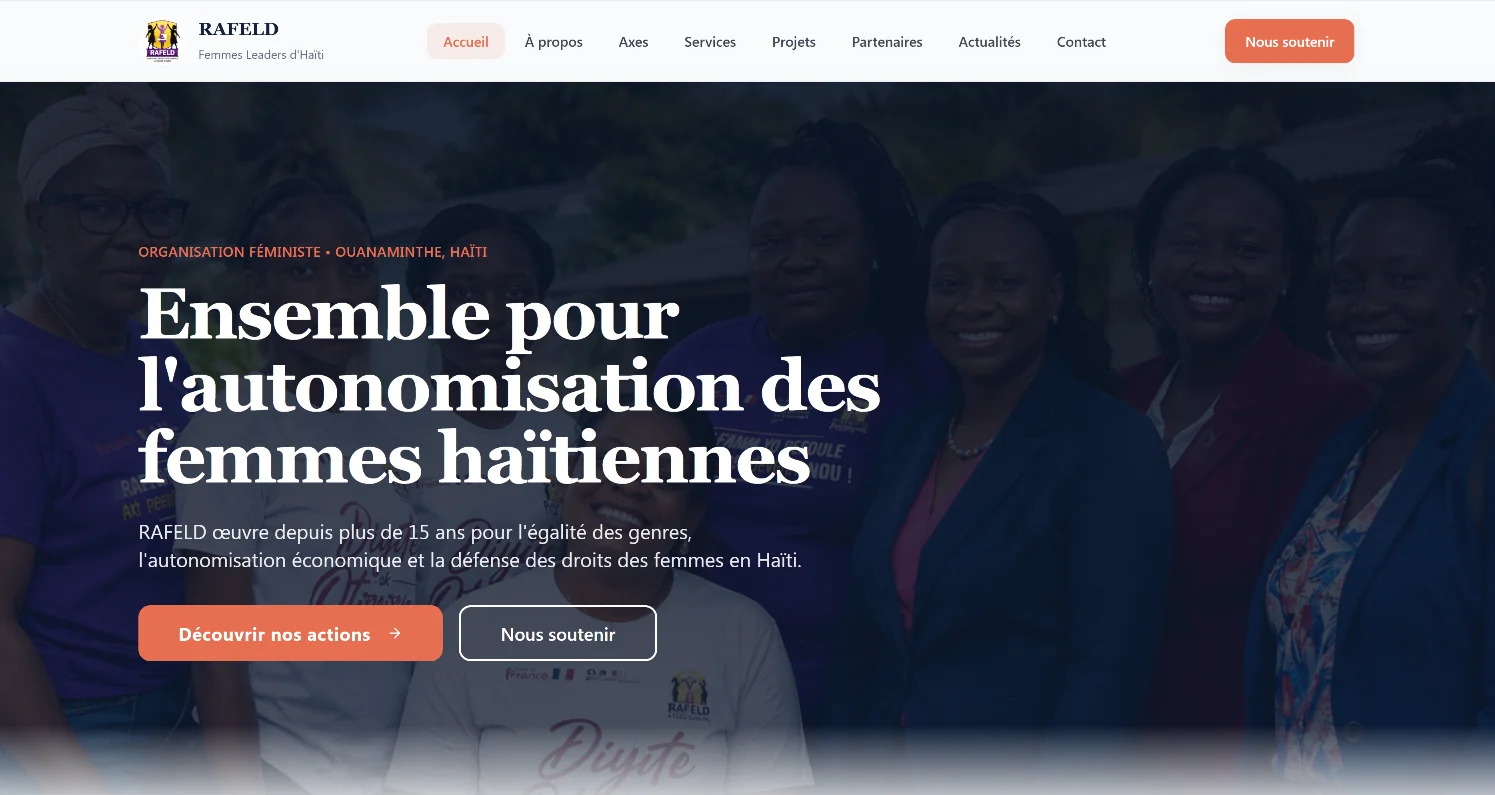
digitalImage evidence

RAFELD Institutional Website Homepage

RAFELD website homepage featuring the organization’s mission, team imagery, navigation, and public-action links.

RAFELD institutional website homepage, designed to strengthen organizational visibility, public understanding, and access to information.

Visit RAFELD Website ↗
audiovisualVideo evidence

RAFELD Dignity-Centered Audiovisual Awareness Spot

RAFELD awareness spot produced through a controlled human-directed, AI-assisted audiovisual workflow combining visual continuity, voice, editing, subtitles, branding, and quality review.

Human-directed, AI-assisted audiovisual production.

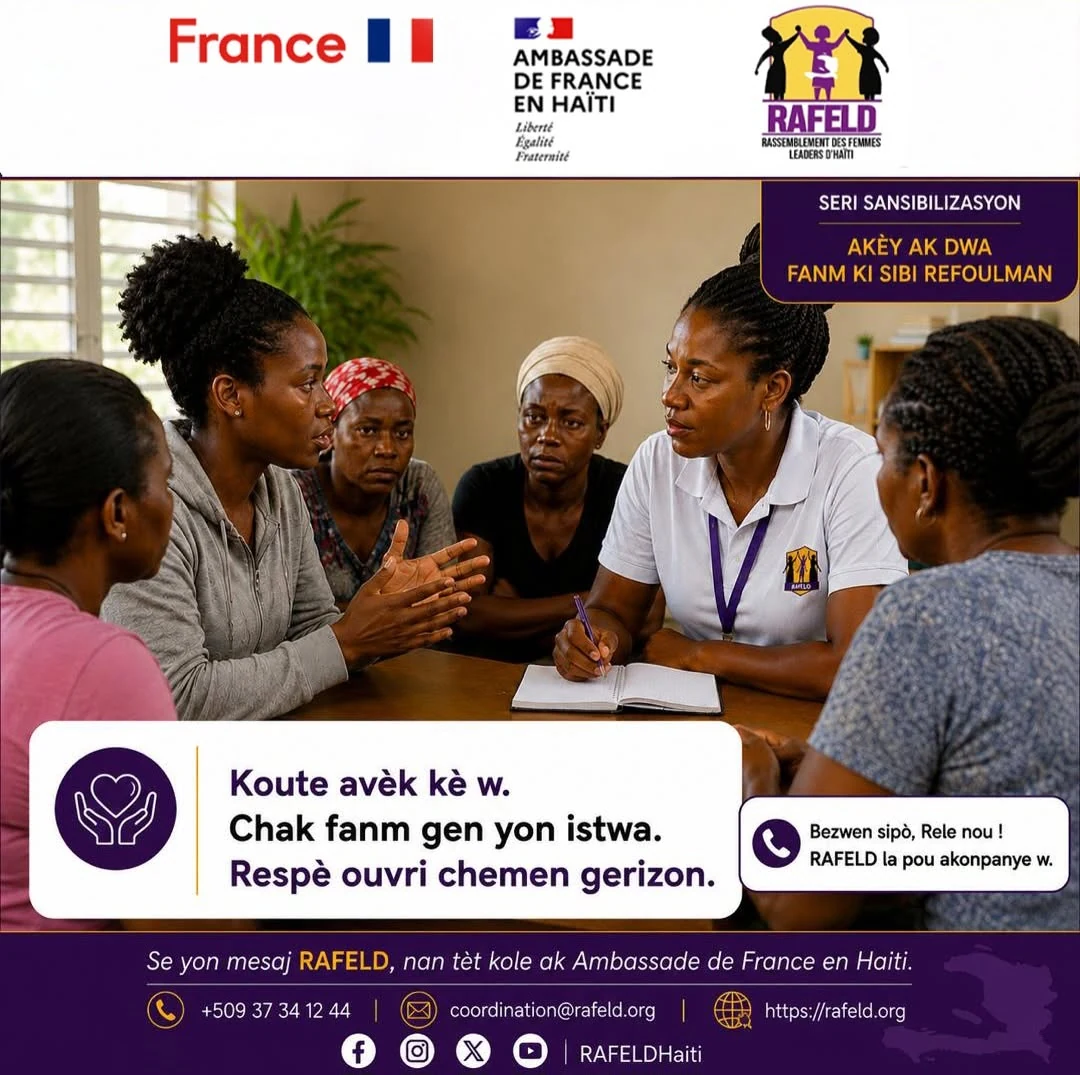
campaignImage evidence

Dignity-Centered Awareness Postcard

RAFELD awareness postcard illustrating a respectful listening and support session for women affected by forced return.

Dignity-centered awareness postcard developed for RAFELD’s communication with women affected by forced return, using Haitian Creole messaging and human-directed AI-assisted visual production.

AI-assisted illustrative awareness visual — not documentary evidence.

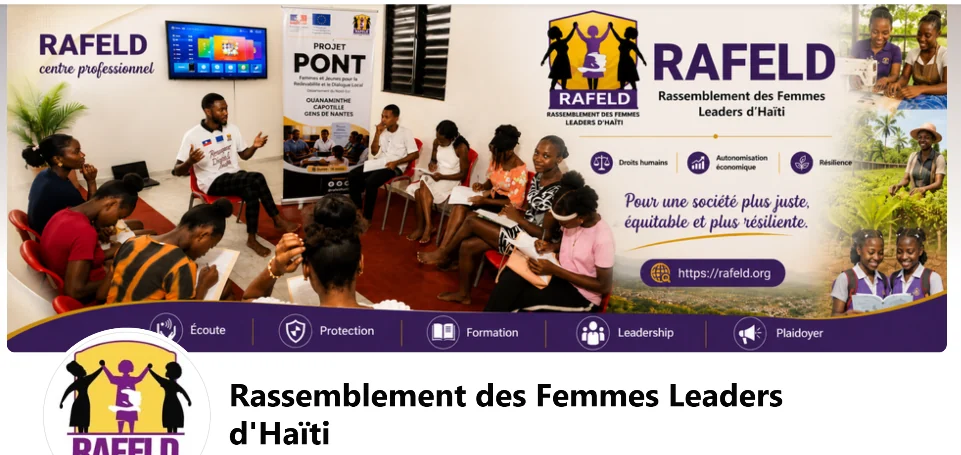
digitalImage evidence

RAFELD Public Facebook Presence

RAFELD Facebook page cover and profile identity showing the organization’s public brand presentation.

RAFELD’s public Facebook presence, supporting institutional visibility, brand consistency, and public communication.

View RAFELD on Facebook ↗
visualImage evidence

RAFELD Official Visual Identity

RAFELD logo featuring three women figures and the organization’s full name.

Official visual identity of Rassemblement des Femmes Leaders d’Haïti — RAFELD.

digitalImage evidence

RAFELD Professional Domain Configuration

Zoho Mail domain administration showing rafeld.org with completed configuration status.

The rafeld.org domain configured through Zoho Mail to support RAFELD’s institutional email and digital communication system.

View full evidence ↗

Additional verified evidence may be connected after validation and publication approval.

Professional Value

A communication initiative becomes stronger when strategy, ethics, systems, and production work together.

  • Strategic Communication

    One architecture linking institutional voice, public message, and campaign expression.

  • Humanitarian Communication

    Dignity-centered representation of sensitive realities without exposure or drama.

  • Institutional Visibility

    A structured public identity supporting credibility, contact, and collaboration.

  • Website Strategy & Development

    Responsive digital presence built for clarity, access, and stable public reference.

  • Campaign Architecture

    Coordinated radio, print, event, and public messaging aligned to one strategic foundation.

  • AI-Assisted Media Production

    Human-directed audiovisual workflow with continuity, ethics, and editorial control.

Lessons

Communication quality is structural — not cosmetic.

  1. LESSON 01

    Consistency requires architecture

    A shared communication foundation is necessary when one initiative appears across websites, radio, print, events, social communication, and audiovisual media.

  2. LESSON 02

    Dignity requires editorial control

    Respectful representation cannot depend on intention alone; it requires terminology, image, privacy, and publication standards.

  3. LESSON 03

    AI requires human continuity management

    AI-assisted production can accelerate creative work, but identity, gesture, context, realism, and message continuity require active human review.

  4. LESSON 04

    Digital presence must support real communication

    A website becomes useful when information, contact pathways, collaboration, professional email, and institutional messaging work as one system.

From communication materials to a communication system

Does your initiative need one clear strategy across institutions, communities, campaigns, and digital channels?

Let’s examine the audience, message, stakeholder, dignity, implementation, and technology requirements — and design a communication system that can work across formats without losing clarity or purpose.